
Every author interview usually starts with getting to know the author, but I think we should do this differently. The Yellow Trumpet is not your debut novel, though it is your first in Nigeria: you’d earlier published two novels in the United States.
How has debuting in Nigeria changed your life and outlook so far?
My book getting published in Nigeria has stirred the desire in me to continue looking toward home. I suppose that was one of the reasons I started writing in the first place, because I thought that, as a Nigerian, I needed to tell Nigerian stories, even though I tend to blend Western techniques into my writing.
Considering that your career borders on the intersection between publishing and writing—you’re the founder of the US-based Dominus Press—how would you describe the niche for African literature in the US market?
African literature is very welcome in America, especially in the Northeast. But unfortunately, I live in the Midwest/West, and African literature hasn’t taken roots here. As a publisher, I see a grand opportunity, and as a writer, I also see the need to tell more African stories and do so in much more detail. Most people that I know read Western fiction—cowboys. Haha. But after they read my work, they would tell me how I transported them to my country without them having to buy plane tickets. That’s the impression I strive to create.
The Yellow Trumpet seems by far your most successful novel. What informed your decision to write The Yellow Trumpet and in so doing touch on sensitive topics like corporate oil theft, Fulani banditry/terrorism enjoying state sponsorship, social neglect, and faith?
I never intended to write the book to begin with. I was writing my epic fantasy—which, by the way, I have resumed writing. Then, the character of Onyeoma came to me, and he was very vivid. At the time, right-wing networks in America were all clamouring about how Christians were being murdered in Nigeria. I suppose it stirred something in me, so I decided to write about it and, while at it, draw on my life experience. My intention is for readers to make their own judgment, and I hope they do so.
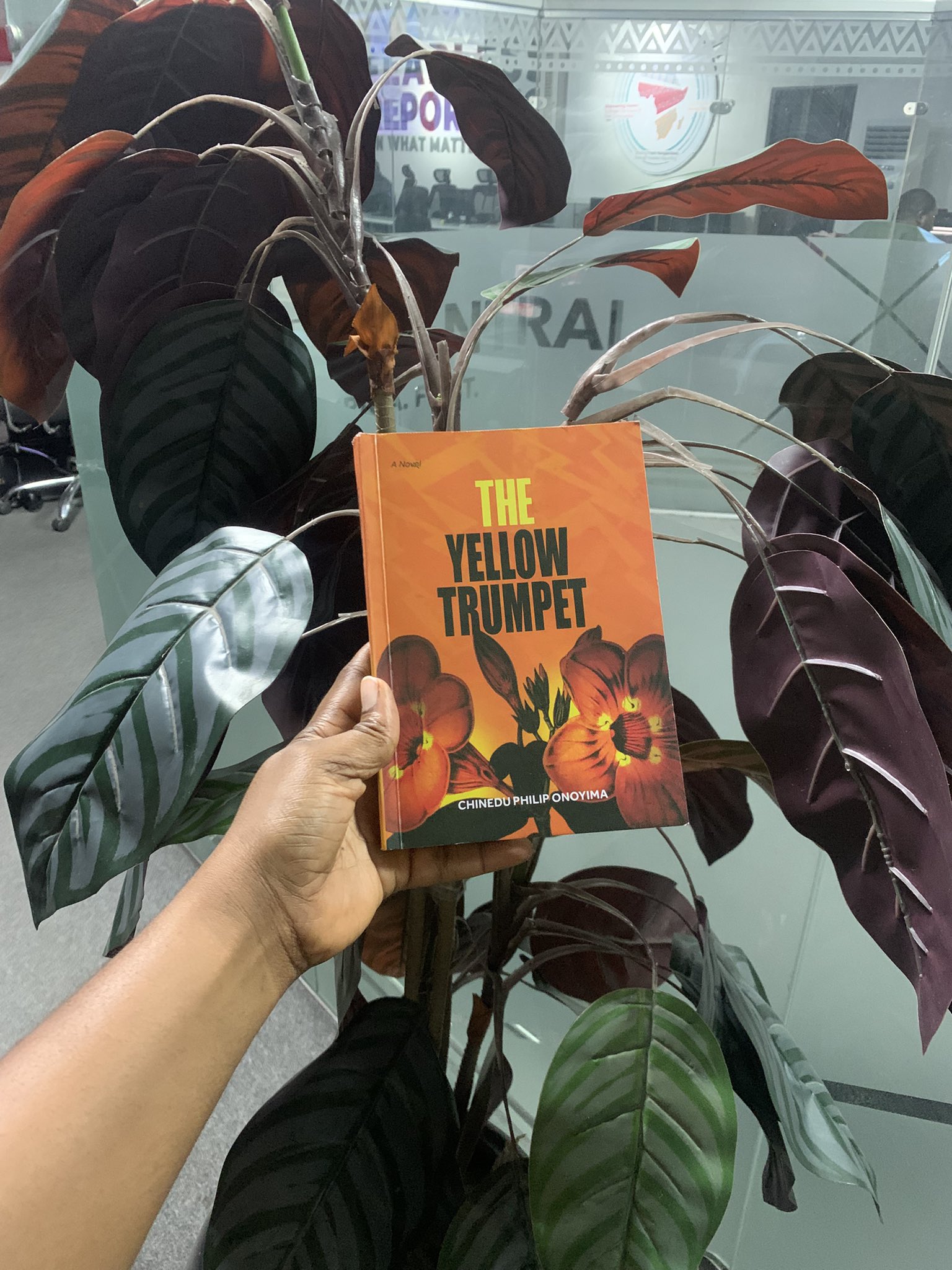
Your main character, Onyeoma, begins The Yellow Trumpet with what appears to be a successful life—a prestigious engineering career, financial stability, and social standing—yet he experiences a profound sense of emptiness. What initially drew you to this contradiction between outward success and inner dissatisfaction?
Onyeoma struck me as Julian Mantle—the main character in The Monk Who Sold His Ferrari. In the first chapter, Onyeoma was chastising his manager. I asked myself why he would do that. At the time, the only reason was that maybe he was rich, and I kept asking myself questions until I fully understood his character. I said to myself, This guy is Julian Mantle. He is not a happy man, and he has to find it. Then I decided to flesh out his religious quandary.
Are you a happy man?
The simplest answer is no. I suppose it kind of reflects in this book.
People give up a lot to migrate out of Africa—your main character did a bit of that, moving temporarily to England for studies. Migrants are also seen to give up everything in their host countries to migrate back to Africa—just as your main character did a bit of, again, moving from the comfort of Enugu to the hinterlands in Agu. Do you think that environment, by default, contributes to happiness? Or do you think that one has to engage themselves in outward or social activity of a transformational kind and, in the course of that, find purpose through which the pursuit of happiness finds constant reward?
This is a fantastic and serious question you have asked. I do believe that environments contribute to our happiness; however, it still depends on us to make ourselves happy. Onyeoma moved away from his city life only to become comfortable in a place with no good roads or even drinking water. The same thing happened to Julian Matle, who abandoned being a lawyer to become a guru. It all comes from inside: what we want and what can elevate our being.
How would you describe your experience of being a Nigerian author of this generation in America? Do you feel the presence of the legacies such as Achebe, J.P Clark, Wole Soyinka—all of whom spent great chunks of their literary and academic careers in the U.S.? Any personal instances or experiences to share?
I think America is a fantastic place. They read all books and are ready to ask questions. It warms my heart knowing that one day, my works will be appreciated. My experience has been wonderful, and Achebe lives on in the memories of those who have encountered his works.
Why, and how, did you begin to write?
I have always loved to imagine stuff, which I have come to realize is the number one ingredient of storytelling. While I was still in Nigeria, I tried writing poetry—especially when I was depressed—and rap punchlines. After I read A Song of Ice and Fire, I told myself that this is how every book should be written. I told myself I wanted to write something as dense as these books. That’s when I started aiming to get my work published.
You are making quite an impression lately in reading circles in Nigeria. Reviews of The Yellow Trumpet have been popping up on social media, Nigerian tabloids—such as The Nation—and in cultural magazines. Should Nigerian readers be looking forward to meeting you at book readings and festival appearances soon?
Yes, I would like that. I’m hoping things will clear up so I’m free next year for events!
... the ideal novel should be the one written for a particular people for a particular reason ...
One final question: everyone talks about The Great American Novel in very clear and expectant terms. I am sure, if you ask any ardent American reader, they would clearly tell you what they mean by it. As a publisher and a writer and think you are a perfect fit to answer this question: what is the ideal Great Nigerian novel?
I think the ideal novel should be the one written for a particular people for a particular reason, and that’s why Things Fall Apart is the ideal Nigerian novel.
Copies of 'The Yellow Trumpet' are available at Tiny Dot. You can order a copy here.